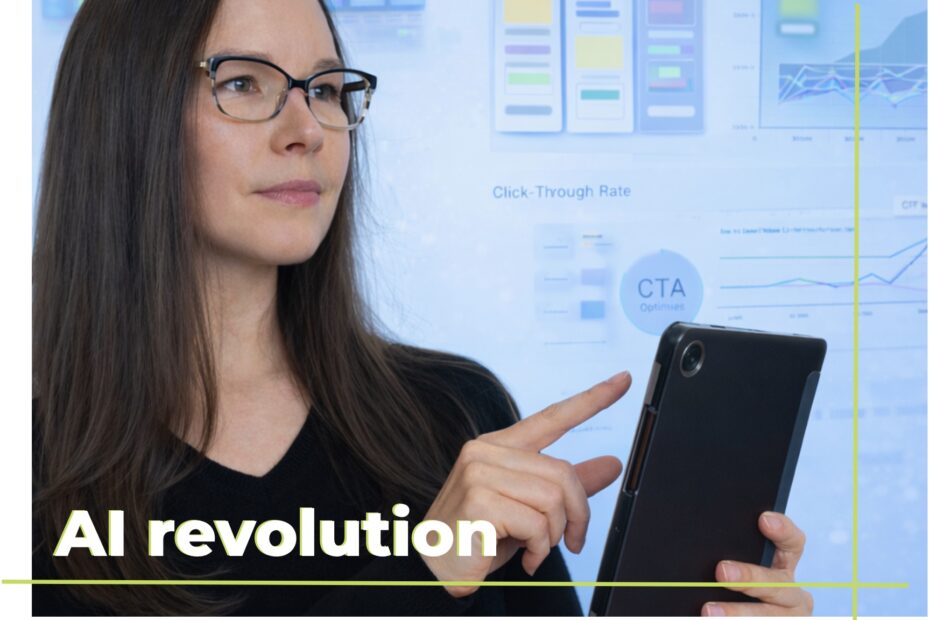
We’ve officially entered a new, and genuinely exciting era of AI. As a result, website conversion rate optimization (CRO) will never look the same.
For digital marketers across the United States, the opportunity is real. Deeper audience understanding, faster experimentation, and the ability to meet website visitors with the right message at exactly the right moment in their journey, at a scale no human team could achieve alone.
But opportunity and execution are two different things. Here’s what CRO professionals need to understand about AI, personalization, and where the conversion lever actually sits in 2025.
Why AI is a game-changer for CRO teams
Traditional conversion rate optimization relied heavily on manual A/B testing, static audience segmentation, and gut-driven hypotheses. The feedback loops were slow, and the ability to act on behavioral signals in real time was limited.
AI changes that equation entirely. Machine learning-driven insights now allow CRO specialists to identify behavioral patterns at scale, predict user intent before a visitor reaches a key decision point, and dynamically adjust messaging, content hierarchy, and calls to action, in ways that would be impossible to test manually.
The result: smarter experiments, faster iteration cycles, and conversion experiences that feel relevant to the user rather than generic.
AI makes personalization scalable. I’ve used ML-driven insights to identify behavioral patterns, predict intent, and dynamically adjust messaging, content hierarchy, and CTAs, in ways that would be impossible to test manually.
The biggest mistake CRO teams make with AI personalization
Most teams treat personalization like a binary switch: either you personalize everything, or you don’t bother. That framing leads to bloated experiments, confused users, and metrics that look good in dashboards until they don’t hold up in revenue.
The better mental model: personalization is progressive. The goal isn’t to create a unique experience for every user on every page. The goal is to deliver the right signal at the right moment to help a visitor make a confident decision.
This distinction matters enormously for US-based digital marketing teams operating in competitive verticals like SaaS, e-commerce, financial services, and education, where the cost of confusion is high and user trust is hard to rebuild once lost.
Where AI adds value and where it adds noise
Not every touchpoint benefits from AI-driven personalization. The discipline is in knowing the difference.
My recommendation for CRO professionals: be deliberate about where AI adds value versus where it adds noise.
Here’s a practical framework:
- High-intent pages (pricing, demo request, checkout): strong AI signal opportunity. Behavioral data and intent prediction can meaningfully influence CTA copy, urgency messaging, and content hierarchy.
- Discovery and awareness pages: lighter touch. Personalization here risks over-engineering a stage where broad clarity outperforms narrow targeting.
- Trust-critical pages (about, testimonials, security): proceed with caution. Dynamically altering social proof or credibility signals can introduce inconsistency that erodes rather than builds confidence.
Over-personalization also has a cost most teams don’t measure: when users feel tracked rather than helped, trust drops, and so does conversion. There is a real line between relevant and intrusive, and AI will not draw it for you.
The real conversion lever: trust and cognitive load
Trust and clarity aren’t nice-to-haves in CRO, they are the conversion lever.
AI should reduce cognitive load, not introduce confusion. When a visitor lands on a high-intent page, their decision-making process is already taxed. Every unnecessary element, a mismatched CTA, a poorly timed modal, an overcrowded content hierarchy, increases friction and decreases the probability of conversion.
The best AI-powered CRO implementations I’ve seen in the US market share one thing in common: they simplify. They remove steps, clarify choices, and guide users toward confident decisions, whether that decision is signing up, requesting a demo, or enrolling in a program.
AI should be the mechanism that makes that simplification scalable, not the source of new complexity.
AI should reduce cognitive load, not introduce confusion. Trust and clarity aren’t nice-to-haves, they’re the conversion lever.
A note on AI and high-stakes decisions
This is especially true in industries where users are making significant life decisions, such as education, healthcare, and financial planning. In these contexts, the CRO mandate isn’t to push harder toward conversion. It’s to remove the friction that prevents a qualified visitor from making a decision they’re already considering.
AI used well in these verticals guides users through complexity: surfacing relevant affordability information, clarifying time commitments, connecting features to outcomes. It feels supportive, not sales-driven. That tone is not just better UX, it consistently outperforms aggressive personalization in long-term conversion and retention metrics.
Key takeaways for US digital marketers and CRO professionals
- AI makes CRO scalable, but deliberate application outperforms blanket personalization every time.
- Treat personalization as progressive, and match signal depth to decision stakes.
- The conversion lever is trust and cognitive simplicity, not the sophistication of your personalization stack.
- AI should surface patterns; human judgment should drive creative and strategic responses to those patterns.
- Measure what AI adds in trust and clarity, not just click-through and surface-level engagement metrics.
Want to apply these principles to your website?
If you’re a marketing team, growth leader, or digital strategist looking to build an AI-powered CRO strategy that drives confident decisions, not just clicks, let’s talk.
I work with US-based organizations to audit conversion experiences, identify high-value personalization opportunities, and implement ML-driven CRO programs grounded in user trust. Reach out to start a conversation.