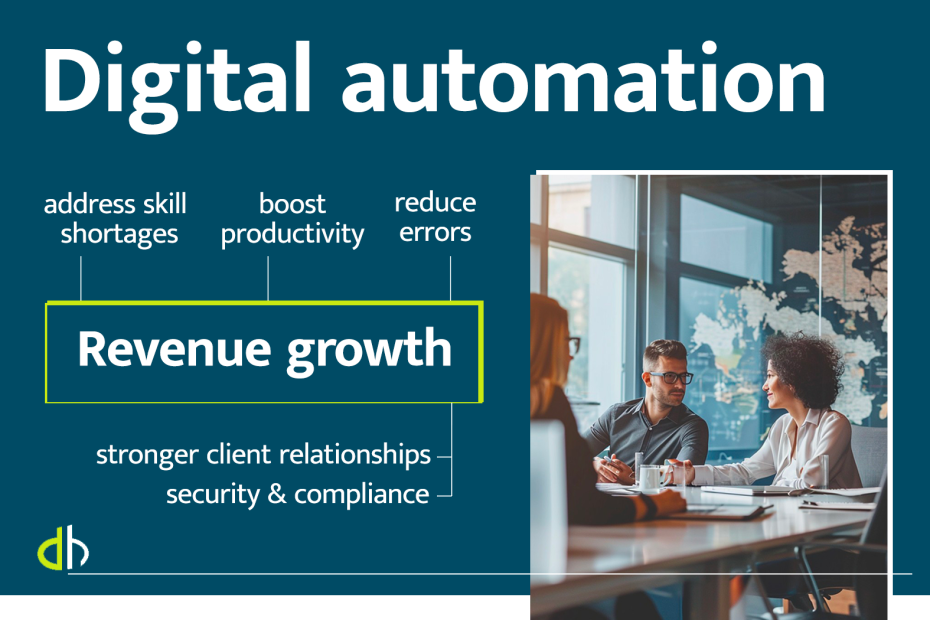
In today’s fast-paced digital economy, automation has evolved from a competitive advantage to a fundamental business necessity. Companies that effectively implement digital automation are experiencing measurable gains in efficiency, productivity, and revenue growth, while those that hesitate risk falling behind in an increasingly automated marketplace.
Why automation is essential for modern business
Digital automation serves as the backbone of contemporary business operations, enabling companies to streamline processes, minimize human errors, and redirect valuable human resources toward strategic initiatives. The numbers tell a compelling story: the Process Automation Market is projected to grow from $13 billion in 2024 to $23.9 billion by 2029, while the broader digital process automation market is valued at $15.4 billion in 2025 and projected to reach $26.66 billion by 2030.
But automation’s effectiveness depends critically on integration quality. Seamless integration ensures data flows effortlessly across your company’s infrastructure, enabling better data transfer, analysis, and decision-making. This integrated approach doesn’t just enhance productivity, it directly drives revenue by enabling faster, more informed business actions.
The measurable benefits of automation
Revenue growth and cost reduction
Automation streamlines operations while simultaneously reducing costs, creating higher profit margins and sustainable revenue growth. Businesses using automation report cost reductions between 10% and 50%, primarily by automating repetitive tasks and minimizing manual errors. More impressively, organizations implementing robotic process automation have seen ROI improvements ranging from 30% to 200% within the first year of deployment.
The financial impact extends beyond simple cost cutting. Finance teams save over 500 hours annually by automating payment processes, with companies reporting an average of $46,000 per year saved from fewer errors and less manual work. These efficiency gains translate directly to bottom-line improvements.
Enhanced productivity and addressing workforce challenges
Automated systems assume responsibility for repetitive, time-consuming tasks, allowing skilled workers to focus on high-value activities requiring human creativity and strategic thinking. Employees using AI report an average 40% productivity boost, with controlled studies showing 25-55% improvements depending on function.
This shift not only improves work quality but also addresses skilled worker shortages by maximizing existing workforce efficiency. According to Gartner, 69% of day-to-day managerial work will be entirely automated by 2024, freeing managers to focus on strategy, innovation, and team development rather than administrative tasks.
Improved efficiency and accelerated decision-making
Automation frees employees from repetitive work, increasing overall productivity and enabling organizations to accomplish more with fewer resources. Beyond task completion, automated systems provide real-time data and analytics that enable quicker, data-driven decisions. This responsiveness allows businesses to capitalize on opportunities and respond to market changes more rapidly than competitors.
Superior data management and error reduction
Automated data handling dramatically improves accuracy and accessibility, enabling more informed decision-making. With better data management, businesses gain deeper operational insights and can make strategic decisions based on reliable information.
Critically, automation minimizes human error risk, leading to higher quality and consistency. AI-powered loan processing has achieved a 90% increase in accuracy and 70% reduction in processing times, demonstrating automation’s potential to transform accuracy-critical processes.
Enhanced customer satisfaction and loyalty
Personalized, automated interactions ensure customers feel valued, driving loyalty and repeat business. Automation enables more consistent and timely communication, enhancing the overall customer experience and fostering long-term relationships that convert one-time customers into brand advocates.
A 2024 survey found that 41% of marketing decision makers have already significantly automated their customer journeys, recognizing that automated personalization at scale was previously impossible without AI-powered tools.
Strengthened security and compliance
Automated data handling and monitoring reduce breach risks and ensure sensitive information security. With robust security measures in place, businesses protect their data and maintain customer trust. Automated processes also ensure adherence to regulatory requirements, reducing non-compliance risk. AI helps organizations automate 51-75% of compliance tasks, with 38% of businesses cutting compliance task time by over 50%.
The transformation from manual to AI-powered automation
The evolution from manual processes to automated systems and full digital integration is transformative, with artificial intelligence playing an increasingly crucial role. Historically, businesses relied on labor-intensive, error-prone manual methods. While basic automation brought efficiency improvements, AI extends capabilities by handling complex data analysis quickly and accurately.
78% of organizations now use AI in at least one business function in 2025, up from 55% in 2023, reflecting AI’s rapid mainstream adoption. AI excels at sifting through vast data volumes, identifying patterns, and providing actionable insights, making it invaluable in today’s data-driven business environment.
AI enables predictive analytics and real-time decision-making, allowing businesses to forecast trends, optimize operations, and personalize customer experiences. These capabilities drive strategic initiatives and create sustainable competitive advantages. Generative AI is projected to deliver labor cost savings of roughly 25 percent on average from adopting current AI tools, with AI’s contribution to productivity growth peaking in the early 2030s with an annual contribution of 0.2 percentage points in 2032.
Scaling business effectively with automation
Automation enables businesses to scale operations without proportional increases in costs or resources. As businesses grow, automated systems efficiently handle increased workloads, supporting sustainable expansion.
The transition from manual to automatic processes creates effective digital workflows that promote active collaboration between internal departments and external vendors. Automated digital workflows ensure transparency, providing clear visibility into potential issues, gaps, and errors that could cause revenue loss or operational inefficiencies.
60% of companies had implemented automation by 2024, with adoption rates expected to keep climbing, and projections suggest 85% of businesses will have automated at least one process by 2029. This widespread adoption reflects automation’s proven value in driving business growth.
Implementation considerations
While automation benefits are substantial, implementation requires careful planning. 57% of companies implementing RPA struggle to scale beyond initial use cases, often due to integration challenges, process complexity, employee resistance, and inadequate training.
Successful automation initiatives require:
- Well-defined, high-impact processes as starting points
- Investment in change management and employee training
- Treatment of automation as business transformation, not merely an IT project
- Regular measurement against established KPIs
- Continuous refinement based on performance data
- Personalized customer experience
The bottom line
Embracing digital automation is no longer optional for businesses seeking effective scaling. From improving productivity and building stronger client relationships to ensuring cybersecurity and leveraging AI for complex data analysis, the benefits are clear and measurable. AI adoption delivers $3.70 ROI per dollar invested on average, though success requires strategic planning and execution.
Automation isn’t simply a strategy or trend, it’s a fundamental requirement for thriving in today’s digital age. The question isn’t whether to automate, but how quickly and effectively you can implement automation to drive your business forward.
Ready to take your business to the next level through automation? Start by identifying high-impact processes, establishing clear success metrics, and implementing these strategies systematically. Watch your business scale with measurable improvements in efficiency, productivity, and profitability.