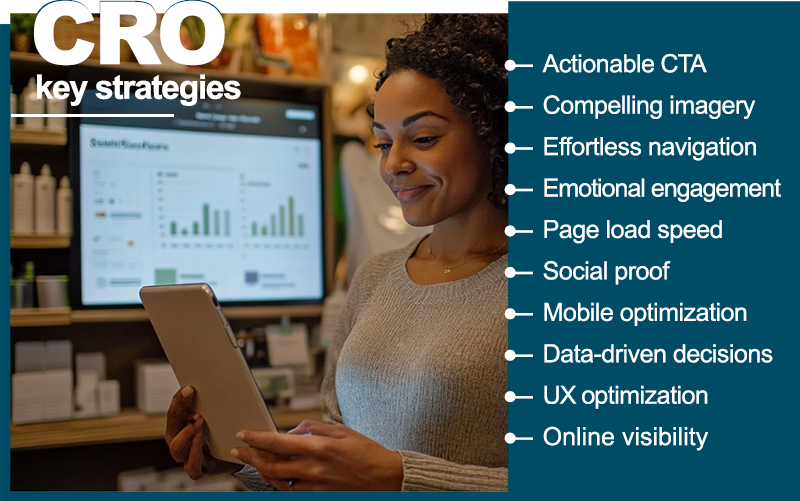
Conversion rate optimization (CRO) is the strategic process of understanding user behavior and systematically refining every element of your website to increase the percentage of visitors who take desired actions. Whether you’re looking to drive purchases, generate newsletter signups, secure appointment bookings, or capture qualified leads, implementing evidence-based CRO strategies can transform your website from a passive digital presence into an active revenue generator.
With the right approach, you can guide visitors seamlessly through their journey and significantly improve your bottom line. Research demonstrates that even a modest 1% improvement in conversion rate can translate to substantial increases in revenue, leads, and return on marketing investment. Let’s explore the most effective, data-backed CRO techniques that are delivering results in 2025.
Conversion rate optimization tips:
Calls to action: the gateway to conversion. Your call-to-action (CTA) button represents one of the most influential conversion elements on your website. Strategic CTA optimization involves far more than simply choosing a bright color, it combines persuasive copywriting, optimal placement, and psychological principles to guide users from passive browsing to active engagement.
Action-oriented language drives results. Use compelling action verbs such as “discover,” “get started,” “create your account,” “download now,” and yes, even the direct “shop now.” While “shop now” may initially sound pushy to some marketers, extensive research consistently shows it significantly boosts click-through rates by removing ambiguity about the next step.
Real-world examples validate this approach: Netflix famously increased signups by shifting from the generic “Register” to the value-driven “Join free for a month.” Similarly, Spotify’s “Get Spotify free” immediately highlights the no-cost benefit, reducing friction and decision-making anxiety.
Strategic placement is non-negotiable. Your primary CTA must always appear above the fold, ensuring immediate visibility across all devices, desktop, mobile, and tablet. Since research shows users rarely scroll extensively on initial page visits or engage deeply with long text blocks, a prominently positioned, compelling CTA dramatically increases the likelihood of conversion. Consider implementing sticky CTAs that remain visible as users scroll for high-intent pages like product details or service offerings.
Visual content: creating emotional connection through imagery
A well-designed website should communicate its core value proposition within seconds, and powerful imagery is essential to achieving this goal. Visual content serves as the emotional hook that captures attention and creates memorable first impressions.
The power of authentic imagery. Consider the difference between a text-only donation page and one featuring a full-screen image of a mother and daughter in a rural setting, with the child making direct eye contact with the viewer, paired with a clear, impactful headline like “Girls can begin walking for water as young as 4 years old.” The visual approach creates an immediate emotional connection that drives action: more donations, higher conversion rates, and a more effective website overall.
Why eye contact matters. Eye contact in imagery is particularly compelling because it humanizes the digital experience, transforming your website from feeling mechanical to personal. Research in visual psychology confirms that images with direct eye contact capture attention longer and create stronger emotional responses. By leveraging high-quality, authentic visuals (as opposed to generic stock photography), you can instantly capture attention, build trust, and drive meaningful engagement.
Best practices for visual optimization:
- Use high-resolution images that load quickly through proper compression
- Feature real people over illustrations when showcasing human elements
- Ensure images align with your brand message and target audience
- Optimize alt text for accessibility and SEO benefits
- Test different image styles to identify what resonates with your audience
Navigation and usability: eliminating friction from the user journey
A seamless, intuitive user experience is fundamental to maximizing conversions. Every additional click, unnecessary form field, or moment of confusion represents a potential exit point where you might lose a prospect. Modern CRO demands ruthless elimination of friction.
Streamline the checkout process. If your site includes e-commerce functionality, implement a one-page checkout whenever possible, with pre-filled fields drawing from user accounts or browser data. Research consistently shows that reducing checkout steps from five to three pages can increase conversion rates by 50% or more. Allow guest checkout options, as many users abandon carts when forced to create accounts.
Make key actions persistently accessible. For appointment-based businesses, ensure the booking button remains consistently visible across the site through sticky navigation or strategic placement on every page. Similarly, donation-focused websites should display the full donation form directly on the main page rather than hiding it behind a “donate” button, this reduces drop-off rates and encourages immediate action by eliminating unnecessary steps.
Follow the single-action principle for landing pages. When directing traffic from advertisements, email campaigns, or organic search, your landing pages should focus laser-sharp on one specific goal: completing a purchase, signing up for a trial, downloading a resource, or booking a consultation. Research from companies like Unbounce shows that focused landing pages outperform generic homepages by 5-10x. Overloading visitors with multiple options, navigation menus, or competing CTAs leads to decision paralysis, confusion, and ultimately higher bounce rates.
Clarity and emotional engagement: the psychology of conversion
Clear communication and emotional resonance are essential for persuading users to take action. Your website should never leave visitors confused about what to do next or why they should care about your offering.
Define your value proposition clearly. Every page should feature a well-articulated value proposition that immediately communicates the benefit to the user. Answer the implicit questions: “What’s in it for me?” and “Why should I choose you?” within the first few seconds of a page load. Use clear, benefit-focused headlines rather than clever but vague messaging.
Leverage emotional triggers. Research in consumer psychology confirms that emotion drives decision-making more powerfully than logic alone. Instead of focusing solely on product features or service descriptions, consider the emotional experience you’re selling. Are you offering peace of mind through security? Excitement through adventure? Relief from a painful problem? Joy through connection? By tapping into these emotional triggers, you create a more persuasive and effective user journey that resonates on a deeper level.
Create a logical information hierarchy. Structure content so users naturally flow from awareness to interest to desire to action. Use headlines, subheadings, and visual cues to guide the eye through your intended narrative. Each section should logically build on the previous one, creating momentum toward conversion.
Page load speed and mobile optimization: speed as a competitive advantage
Website performance has emerged as one of the most critical factors influencing conversion rates in 2025. With user attention spans shorter than ever and mobile commerce growing at 29% annually, every millisecond counts.
The data is unambiguous. Recent studies reveal that conversion rates can drop by up to 4.42% with each additional second of load time in the critical 0-5 second window. Sites loading in 1 second achieve conversion rates up to 2.5x higher than those taking 5 seconds. More dramatically, the probability of a bounce increases by 32% when page load time increases from 1 to 3 seconds, and by 90% when it goes from 1 to 5 seconds. (Note: These statistics are based on industry research from Portent, Google, and other performance studies from 2024-2025.)
Nearly 70% of consumers admit that page speed impacts their willingness to buy from an online retailer. For mobile users specifically, 53% will abandon a site if it takes longer than 3 seconds to load, representing a massive potential loss given that mobile devices now account for approximately 70% of online shopping traffic.
Optimization strategies that work:
- Compress images without sacrificing quality using modern formats like WebP
- Implement a content delivery network (CDN) to serve content from geographically closer servers
- Minimize unnecessary JavaScript and CSS files
- Enable browser caching for returning visitors
- Prioritize above-the-fold content loading
- Regularly monitor Core Web Vitals (LCP, FID/INP, and CLS) using Google’s tools
Mobile optimization is non-negotiable. Beyond speed, ensure your site delivers an exceptional mobile experience. Buttons should be easily tappable (minimum 44×44 pixels), forms should minimize typing requirements, navigation should be intuitive for touchscreen interactions, and content should be readable without zooming. Consider implementing mobile-first design principles, where you design for mobile constraints first, then scale up for larger screens.
Social proof and trust signals: building credibility through transparency
In an increasingly competitive digital marketplace where users discover new brands daily, trust signals have become essential conversion drivers. When someone encounters your brand for the first time, you have mere seconds to establish credibility and confidence.
Leverage multiple forms of social proof. Incorporate customer reviews, detailed testimonials with real names and photos, case studies with specific results, and user-generated content from social media or third-party review platforms. Research shows that 93% of buyers read online reviews before making a purchase decision, making visible social proof crucial for easing prospects toward conversion.
Display trust badges strategically. Include security certifications (SSL, payment processor badges), money-back guarantees, industry awards or recognitions, and logos of well-known clients or media mentions. Position these elements near conversion points like add-to-cart buttons, form submissions, or checkout pages where trust concerns are highest.
Quantify your credibility. Instead of vague claims, use specific numbers: “Trusted by 10,000+ customers,” “Rated 4.8/5 stars from 2,500+ reviews,” or “Featured in The New York Times, Forbes, and TechCrunch.” Specificity builds credibility in ways that generic claims cannot.
A/B testing and data-driven optimization: the foundation of continuous improvement
Sustainable conversion rate optimization requires ongoing experimentation and iteration based on real user data, not assumptions or best practices borrowed from other companies. What works for Amazon may not work for your specific audience, context, or business model.
Implement systematic testing. A/B testing (also called split testing) allows you to compare two versions of a webpage, headline, CTA, image, or layout to determine which performs better with your specific audience. By showing version A to one segment and version B to another, you can make data-driven decisions that continuously improve performance. Companies like Booking.com and Airbnb run thousands of tests annually, treating optimization as an ongoing process rather than a one-time project.
Testing best practices:
- Test one variable at a time to isolate impact (changing headline, image, and button color simultaneously makes it impossible to know which caused the improvement)
- Ensure statistical significance, typically requiring at least 5,000+ visitors per week and 200+ conversions to reach reliable conclusions
- Run tests long enough to account for day-of-week and time-of-day variations (minimum 1-2 weeks)
- Document learnings to build institutional knowledge
- Prioritize tests based on potential impact and ease of implementation
Analyze user behavior comprehensively. Beyond A/B testing, use heatmaps to see where users click and scroll, session recordings to watch real user journeys, and funnel analytics to identify where users drop off. Tools like Hotjar, Contentsquare, or Microsoft Clarity provide invaluable insights into the gap between your intended user journey and actual behavior.
Avoid copying competitors blindly. Just because a competitor uses a specific design or feature doesn’t mean it’s effective for them, or that it will work for you. Different audiences, value propositions, and business models require different optimization approaches. Always test assumptions with your own data.
Personalization: tailoring experiences to individual users
Personalization has evolved from a nice-to-have to a fundamental expectation in 2025. Modern users expect experiences tailored to their preferences, behavior, location, and needs, all delivered in real-time.
Implement meaningful personalization. Use available data to customize content, offers, product recommendations, and messaging based on user behavior (pages visited, items viewed), demographics (location, device type), or purchase history (for returning customers). For example, displaying recommended products based on browsing activity or using personalized email campaigns can significantly boost conversion rates. Research indicates that 89% of marketers see positive ROI from personalization campaigns.
Balance personalization with privacy. Be transparent about data collection and use, comply with regulations like GDPR and CCPA, and always provide value in exchange for information. Users are increasingly sophisticated about data privacy and will abandon brands they perceive as invasive or creepy.
Final thoughts: treating CRO as an ongoing discipline
Conversion rate optimization is fundamentally about reducing friction, enhancing clarity, establishing emotional connections, and continuously learning from user behavior. Every element of your website, from headline copy to button placement to page load speed, either moves users closer to or further from conversion.
The most successful companies treat CRO not as a one-time project but as an ongoing discipline requiring continuous attention, testing, and refinement. By implementing these evidence-based practices consistently: compelling CTAs positioned strategically, powerful visual storytelling, frictionless user journeys, blazing-fast page speeds, prominent trust signals, systematic A/B testing, and thoughtful personalization, you can transform casual visitors into loyal customers and drive sustainable, long-term business growth.
Start with quick wins (improving page speed, clarifying CTAs, adding social proof), then build toward more sophisticated optimizations as you gather data and insights about your specific audience. Remember, conversion optimization is a marathon, not a sprint, the businesses that commit to continuous improvement will consistently outperform those that treat their website as “finished.”