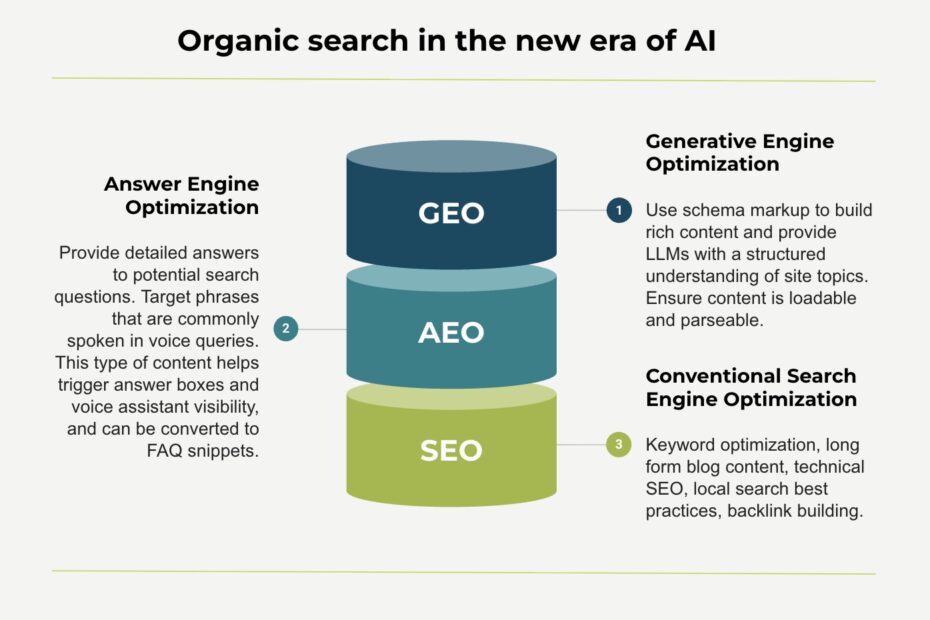
If you’ve been in digital marketing for a while, you’ve probably noticed something shifting. People are asking ChatGPT for recommendations. They’re using Perplexity to research purchases. Google’s AI Overviews now appear on billions of searches every month. The way people discover information is fundamentally changing. Welcome to the era of Generative Engine Optimization, or GEO for short.
Note: While these statistics reflect reported trends as of mid-2025, AI adoption rates continue to evolve rapidly. Always verify current data for strategic planning.
The writing is on the wall: AI-powered search is growing fast, and brands that ignore it risk becoming invisible where their audiences are increasingly looking for answers.
How GEO differs from traditional SEO
While SEO and GEO share common foundations, they optimize for fundamentally different outcomes.
Traditional SEO focuses on ranking in search results, aiming to drive clicks and traffic from search engines like Google and Bing. When users search, they receive lists of links to explore. In contrast, Generative Engine Optimization focuses on being cited in AI responses, optimizing for references and mentions within AI platforms like ChatGPT, Claude, and Perplexity. Instead of providing lists of links, these generative engines synthesize information and present direct, comprehensive answers.
This fundamental difference changes the game. Your content doesn’t just need to be findable—it needs to be the source AI systems trust and cite when generating responses. The good news: GEO best practices are familiar.
Here’s the reality that might surprise you: most GEO best practices are just solid SEO principles applied with AI in mind. GEO doesn’t replace SEO; it extends it. The brands showing up in AI-generated answers are usually the same ones dominating organic search. If you’ve invested in quality SEO, you’re already most of the way there.
Let’s break down the core practices that optimize for both traditional search engines and AI systems.
How to optimize your website for AI search
1. Provide clear, concise answers to common questions
AI systems prioritize content that directly answers user questions. Structure your content to:
- Identify the questions your audience is asking (use tools like Answer the Public, forums, or customer support inquiries)
- Provide direct answers early in your content—ideally in the first paragraph
- Use natural, conversational language rather than keyword-stuffed copy
- Address specific user intent (informational, navigational, or transactional)
Example: Instead of writing “Our product features include X, Y, and Z,” try “How does [Product] help [solve problem]? It provides three key solutions…”
2. Update content regularly
AI platforms like Perplexity prioritize content that’s current and up-to-date, with some indexing content daily. Stale content gets deprioritized. Best practices for keeping content fresh:
- Review and update cornerstone content at least annually
- Add publication and “last updated” dates to articles
- Prioritize refreshing articles with titles like “Best,” “Top,” or date-specific content
- Use a content calendar to track when pages need updates
- Update statistics, case studies, and examples with recent data
Disclaimer: While regular updates are widely recommended, the exact refresh frequency that optimizes AI visibility is still being studied. Focus on genuine improvements rather than superficial changes.
3. Use bulleted and numbered lists for better readability
Lists do double duty: they improve readability for humans and help AI systems extract key information efficiently. When to use lists in your content:
- Breaking down multi-step processes
- Presenting features, benefits, or options
- Summarizing key takeaways
- Answering “what,” “why,” or “how” questions with multiple points
AI engines can easily parse well-structured lists, making your content more likely to be cited in generated responses.
4. Ensure clear heading structure (H1, H2, H3)
Proper heading hierarchy isn’t just good practice, it’s essential for AI comprehension:
- Use one H1 per page (your main title)
- Structure content logically with H2 subheadings for main sections
- Use H3 and H4 for subsections
- Make headings descriptive and question-based when appropriate
- Avoid skipping heading levels (don’t jump from H2 to H4)
Think of headings as the table of contents that both search engines and AI systems use to understand your content’s structure and extract relevant sections.
5. Optimize robots.txt and XML sitemaps for LLM crawlers
Technical accessibility is crucial, ensuring AI crawlers can easily access and understand your content is foundational to GEO. Technical optimizations include:
For robots.txt:
- Ensure your robots.txt file allows access to important pages
- Don’t block CSS, JavaScript, or resources AI crawlers need to render pages
- Be careful not to accidentally block entire sections of your site
For XML sitemaps:
- Create and submit XML sitemaps to search engines
- Keep sitemaps updated with new and modified content
- Include last modification dates to signal content freshness
- Submit sitemaps through Google Search Console and Bing Webmaster Tools
Note: As of late 2025, some discussions have emerged around specialized formats like “llms.txt” for AI systems, but these remain experimental. Focus on established standards while monitoring industry developments.
6. Ensure mobile-friendliness and fast load times
Site performance matters as much for AI visibility as it does for traditional SEO:
Mobile optimization:
- Use responsive design that adapts to all screen sizes
- Ensure text is readable without zooming
- Make buttons and links easy to tap
- Test your site on actual mobile devices
Speed optimization:
- Compress images and use modern formats (WebP, AVIF)
- Minimize CSS and JavaScript
- Enable browser caching
- Use a content delivery network (CDN)
- Aim for Core Web Vitals scores in the “Good” range
Google’s tools like PageSpeed Insights and Mobile-Friendly Test can help identify specific improvements.
Additional GEO best practices to consider
While the fundamentals above are essential, these advanced tactics can further boost your AI visibility:
Implement schema markup
Schema markup helps AI engines understand your content better by providing structured data. Common schema types include:
- Article schema (for blog posts and news)
- FAQPage schema (for question-and-answer content)
- HowTo schema (for instructional content)
- Product schema (for e-commerce pages)
- Organization schema (for company information)
Build authority signals (E-E-A-T)
Experience, Expertise, Authoritativeness, and Trustworthiness remain critical for GEO, with content featuring transparent author bios and reputable citations often outperforming shallow material.
Strengthen your E-E-A-T by:
- Adding detailed author bios with credentials
- Citing authoritative sources
- Earning mentions and backlinks from trusted sites
- Publishing consistently in your niche
- Demonstrating real-world experience and results
Optimize for multiple content formats
AI engines increasingly analyze more than just text. Consider adding:
- Relevant images with descriptive alt text
- Video content that supplements written explanations
- Infographics that visualize complex information
- Charts and data visualizations with proper context
Final thoughts: GEO is just good SEO
Here’s the reality: GEO best practices aren’t revolutionary, they’re foundational principles of quality web content and solid SEO.
Clear answers. Updated information. Well-structured content. Mobile-friendly, fast-loading websites. Accessible sitemaps. These aren’t new concepts invented for AI search, they’re the same practices we’ve been advocating for years.
What’s changed is the consumer of your content. Beyond human visitors and traditional search engines, AI systems are now reading, analyzing, and citing your pages. The good news? If you’ve been doing SEO the right way, focusing on user experience, quality content, and technical excellence, you’re already optimizing for AI.
The brands winning at GEO aren’t reinventing the wheel. You cannot succeed at GEO without solid SEO, weak SEO means invisible GEO. They’re simply applying proven best practices consistently while keeping AI systems in mind as another audience for their content.
So don’t panic about GEO being a completely new field that requires starting from scratch. Instead, double down on what’s always worked: create genuinely helpful content, structure it clearly, keep it updated, make it technically accessible, and build real authority in your space.
That’s GEO. And that’s just good SEO. This post synthesizes current best practices in generative engine optimization as of December 2025. As AI search technologies continue evolving, staying informed about emerging trends and adjusting strategies accordingly will remain essential. The fundamentals, however (quality, clarity, accessibility, and authority) are timeless. Remember: focus on creating genuinely valuable content first, then optimize for discoverability second.