You’ve spent countless hours and dollars driving traffic to your website. Visitors are coming, but they’re not converting. Sound familiar? You’re not alone, and more importantly, there’s a solution.
Conversion rate optimization (CRO) is the practice of systematically improving your website’s ability to turn visitors into customers, subscribers, or leads. Unlike traditional marketing tactics that focus on bringing more people to your site, conversion rate optimization squeezes more value from the traffic you already have.
Think about it: if 10,000 people visit your site monthly and 2% convert, that’s 200 conversions. Increase your conversion rate to just 3%, and you’ve gained 100 additional conversions without spending an extra dollar on ads. That’s the power of conversion rate optimization.
This conversion rate optimization guide will walk you through everything you need to know, from foundational metrics to advanced testing strategies. Whether you’re running an online store, generating B2B leads, or building an email list, you’ll find actionable techniques to boost your results.
Why conversion rate optimization matters more than ever
The digital landscape has become brutally competitive. Ad costs continue climbing while consumer attention spans shrink. Businesses that rely solely on traffic acquisition are fighting an uphill, expensive battle.
Conversion rate optimization flips this equation. Instead of pouring money into attracting more visitors, you focus on making your existing traffic work harder. The result? Lower customer acquisition costs, higher return on ad spend, and more predictable revenue growth.
Here’s what makes conversion rate optimization so valuable:
Better ROI on marketing spend. When you improve conversion rates, every marketing channel becomes more profitable. Your paid ads, organic search traffic, and social media efforts all generate better returns.
Deeper customer insights. The conversion rate optimization process forces you to understand your audience at a granular level. These insights improve not just your website, but your entire business strategy.
Competitive advantage. While your competitors chase more traffic, you’re extracting more value from yours. This efficiency compounds over time, creating a sustainable edge.
Scalability. Once you’ve optimized your conversion funnel, adding more traffic multiplies your results. You’ve built a machine that reliably turns visitors into customers.
Understanding conversion rate optimization fundamentals
Before diving into tactics, let’s establish the foundation. Conversion rate optimization is both an art and a science, requiring creativity and rigorous data analysis.
What actually counts as a conversion?
A conversion is any desired action a visitor completes on your site. This varies by business model:
- E-commerce sites track purchases and add-to-cart actions
- SaaS companies measure free trial signups and demo requests
- Content sites focus on email subscriptions and content downloads
- Service businesses track contact form submissions and phone calls
Your conversion goals should align with your business objectives. Don’t get distracted by vanity metrics that don’t impact revenue.
The metrics that matter in conversion rate optimization
Tracking the right metrics separates effective conversion rate optimization from guesswork. Here are the essential numbers to monitor:
Conversion rate is your north star metric. Calculate it by dividing conversions by total visitors, then multiply by 100. If 100 people visit your landing page and 3 purchase, your conversion rate is 3%.
Bounce rate reveals how many visitors leave after viewing just one page. High bounce rates often signal relevance problems or poor user experience. However, context matters: a blog post with high bounce rate might be perfectly fine if visitors found what they needed.
Average session duration shows how long visitors engage with your site. Longer sessions typically indicate higher interest, though this varies by industry and content type.
Pages per session measures how deeply visitors explore your site. More page views can signal strong engagement, but also might indicate navigation confusion.
Exit rate differs from bounce rate by showing where visitors leave during their journey. High exit rates on key pages (like checkout) reveal critical friction points.
Micro-conversions are small actions that lead to major conversions, like watching a product video or clicking to a pricing page. These early indicators help you understand the path to conversion.
Your conversion rate optimization roadmap
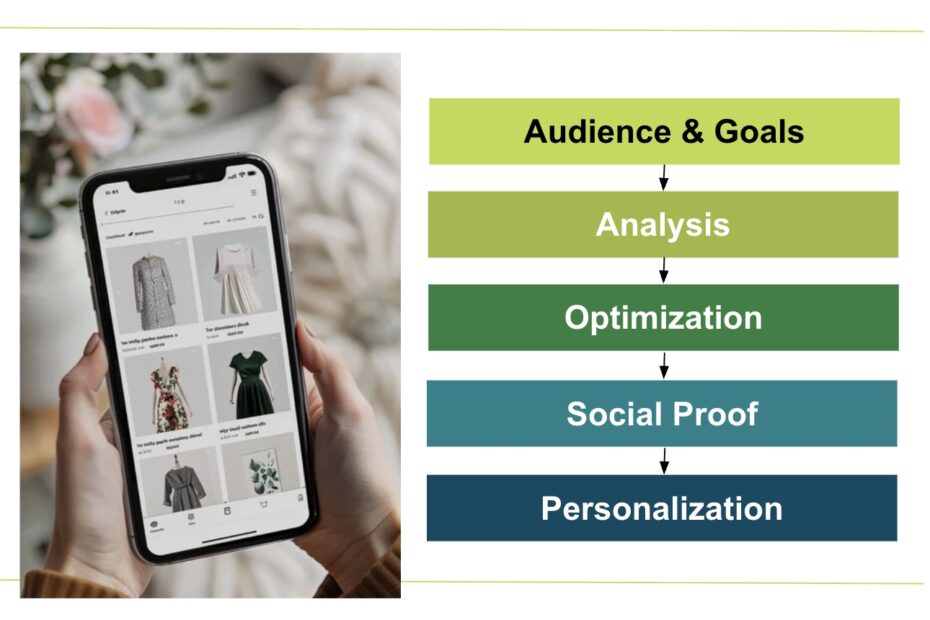
Effective conversion rate optimization follows a systematic process. Here’s how to approach it strategically.
Step 1: Build deep audience understanding
Every successful conversion rate optimization initiative starts with knowing your audience intimately. You can’t optimize for users you don’t understand.
Start with Google Analytics to gather quantitative data: demographics, traffic sources, device usage, and behavior flow. Look for patterns in how different segments interact with your site.
But numbers only tell half the story. Qualitative research reveals the “why” behind the “what.” Conduct user interviews, analyze support tickets, and read customer reviews. What pain points are people trying to solve? What objections prevent them from converting?
Create detailed buyer personas representing your key audience segments. Include demographics, but focus more on goals, challenges, and decision-making criteria. These personas guide every optimization decision.
Use on-site surveys to gather real-time feedback. Ask visitors what nearly stopped them from converting. Their answers will surprise you and point directly to optimization opportunities.
Step 2: Establish clear, measurable goals
Vague ambitions like “improve conversions” lead nowhere. You need specific, measurable targets that provide direction and accountability.
Apply the SMART framework: Specific, Measurable, Achievable, Relevant, and Time-bound. Instead of “increase sales,” aim for “increase product page conversion rate from 2.1% to 2.8% within 60 days by optimizing product descriptions and adding comparison tools.”
Prioritize goals based on business impact. Which conversions drive the most revenue? Which pages get the most traffic? Focus your conversion rate optimization efforts where they’ll create maximum value.
Document your goals and share them across teams. Conversion rate optimization requires buy-in from design, development, content, and marketing. Everyone needs to understand what you’re optimizing for and why.
Step 3: Audit your current performance
You can’t improve what you don’t measure. Conduct a comprehensive analysis of your current conversion funnel to identify opportunities and bottlenecks.
Use Google Analytics to find pages with high traffic but disappointing conversion rates. These represent your biggest opportunities since small improvements affect many visitors.
Deploy heatmap tools like Hotjar or Crazy Egg to visualize user behavior. Where do people click? How far do they scroll? Heatmaps reveal gaps between your assumptions and reality.
Watch session recordings to see real visitors navigate your site. You’ll spot usability issues, confusion points, and unexpected behavior patterns. These qualitative insights complement your quantitative data.
Analyze your conversion funnel to find where visitors drop off. Is it the product page? The cart? The checkout form? Understanding where you lose people tells you where to focus optimization efforts.
Run technical audits to ensure your site performs well. Page speed, mobile responsiveness, and cross-browser compatibility all impact conversion rates. Tools like Google PageSpeed Insights and GTmetrix identify technical barriers.
Step 4: Optimize your landing pages for conversion
Landing pages are conversion battlegrounds. Visitors decide within seconds whether to engage or leave, making optimization critical.
Craft compelling headlines. Your headline is often the first (and sometimes only) thing visitors read. Make it clear, benefit-focused, and specific. “Save 3 Hours Daily With Automated Reports” beats “Great Project Management Software.”
Clarify your value proposition. Within five seconds, visitors should understand what you offer, who it’s for, and why it matters. Remove jargon and focus on tangible benefits.
Use high-quality, relevant visuals. Images should reinforce your message, not just fill space. Show your product in use, display results, or feature real customers.
Write conversion-focused copy. Focus on benefits over features. Instead of “24/7 customer support,” try “Get help whenever you need it, even at 2 AM.” Use short paragraphs, bullet points, and clear language.
Simplify your forms. Every field you add decreases conversion rate. Request only essential information. Consider progressive profiling to gather details over time rather than upfront.
Create clear, actionable CTAs. Buttons should tell users exactly what happens next. “Start Your Free Trial” is more effective than “Submit.” Use contrasting colors to make CTAs visually prominent.
Add strategic social proof. Testimonials, reviews, case studies, and trust badges reduce anxiety and build credibility. Place them near decision points to maximum impact.
Remove distractions. Dedicated landing pages should focus on one goal. Remove navigation menus, sidebars, and competing links that might lead visitors away from converting.
Step 5: Perfect your user experience
User experience and conversion rate optimization are inseparable. Friction anywhere in the journey damages conversion rates.
Streamline navigation. Users should find what they need within three clicks. Use clear labels, logical hierarchies, and prominent search functionality.
Optimize for mobile devices. Over half of web traffic comes from mobile. Your site must work flawlessly on phones and tablets. Test forms, buttons, and checkout flows on actual devices.
Improve page speed. Every second of load time costs conversions. Compress images, minify code, leverage browser caching, and use a content delivery network. Aim for load times under three seconds.
Enhance accessibility. Accessible sites serve more users and often convert better for everyone. Use proper heading structure, alt text for images, sufficient color contrast, and keyboard navigation support.
Reduce cognitive load. Don’t make visitors think harder than necessary. Use familiar patterns, clear labels, and obvious next steps. When in doubt, simplify.
Build trust at every step. Display security badges near payment forms. Use HTTPS throughout your site. Include clear privacy policies and contact information. Trust is conversion fuel.
Step 6: Master A/B testing
A/B testing transforms opinions into data-driven decisions. Instead of guessing what works, you let real users tell you through their behavior.
Start with a clear hypothesis. “Changing the CTA button from green to red will increase clicks because red creates urgency” gives you something specific to test and validate.
Test one element at a time to isolate impact. Change the headline or the image, not both simultaneously. Multiple simultaneous changes make it impossible to know what drove results.
Ensure statistical significance before declaring winners. Use A/B testing calculators to determine required sample sizes. Running tests too short leads to false conclusions.
Test high-impact elements first: headlines, CTAs, value propositions, and form fields. These changes typically move the needle more than minor design tweaks.
Don’t stop after one win. Conversion rate optimization is iterative. Each test generates insights for the next. Small improvements compound into significant gains.
Use tools like Optimizely, VWO, or other similar tools to manage experiments. These platforms handle traffic splitting, statistical analysis, and result tracking.
Step 7: Leverage social proof strategically
Humans are social creatures. We look to others when making decisions, especially unfamiliar ones. Social proof reduces uncertainty and builds confidence.
Customer testimonials work best when specific and believable. “This software saved me 10 hours per week on client reporting” is more compelling than “Great product!” Include names, photos, and companies when possible.
Case studies provide deep proof for high-consideration purchases. Show the problem, your solution, and quantified results. Let prospects see themselves in the success story.
User reviews and ratings are especially powerful for e-commerce. Display them prominently on product pages. Even negative reviews can build trust when you respond professionally.
Trust badges signal security and credibility. Display payment processor logos, security certifications, and industry memberships near checkout processes.
Real-time activity notifications create urgency and social validation. “47 people are viewing this product” or “Sarah from Denver just purchased” encourages action.
Media mentions and awards establish authority. If you’ve been featured in recognized publications or won industry awards, showcase them prominently.
Step 8: Deploy exit-intent technology
Exit-intent popups detect when visitors are about to leave and make one final offer. When done well, they recover conversions that would otherwise be lost.
Offer genuine value. Discounts work for e-commerce, but consider free resources, exclusive content, or consultations depending on your business model.
Keep messaging clear and direct. Visitors are already leaving, so you have seconds to capture attention. State the offer and benefit immediately.
Make the CTA obvious and clickable. Use contrasting colors and clear language. The close button should be visible too; forced engagement creates resentment.
Segment your offers based on visitor behavior. Someone who viewed pricing might respond to a discount, while someone on a blog post might want related content.
Test different triggers and timing. Exit-intent is one option, but also consider time-based popups, scroll-depth triggers, or engagement-based displays.
Step 9: Personalize the experience
Generic experiences convert at generic rates. Personalization tailors your site to individual visitors, dramatically improving relevance and conversion rates.
Dynamic content changes based on visitor characteristics. Show different headlines to new versus returning visitors. Display location-specific offers. Match content to traffic source.
Product recommendations use browsing and purchase history to suggest relevant items. “Customers who bought this also bought…” increases average order value while improving experience.
Email personalization extends beyond using someone’s name. Segment lists by behavior, preferences, and lifecycle stage. Send targeted messages that address specific needs and interests.
Retargeting campaigns bring back visitors who didn’t convert. Show them products they viewed, offer incentives, or provide additional information to overcome objections.
Use data responsibly and transparently. Effective personalization feels helpful, not creepy. Be clear about data usage and provide control options.
Step 10: Commit to continuous optimization
Conversion rate optimization is not a project with an end date. It’s an ongoing discipline that adapts to changing user behavior, market conditions, and business goals.
Establish regular reporting rhythms. Review key metrics weekly, conduct deeper analyses monthly, and perform comprehensive audits quarterly.
Maintain a prioritized backlog of test ideas. Every team member should be able to contribute hypotheses. Evaluate ideas based on potential impact, required resources, and strategic alignment.
Run iterative tests constantly. Even small improvements add up. A series of 5% gains compounds into transformational results.
Collect and analyze user feedback continuously. Behavior data shows what users do, but surveys and interviews reveal why. Both perspectives are essential.
Stay current with conversion rate optimization best practices. Follow industry blogs, attend webinars, and study what successful companies are doing. Adapt proven strategies to your context.
Share insights across your organization. Conversion rate optimization discoveries often have implications for product development, customer service, and marketing strategy.
Essential tools for conversion rate optimization
The right tools make conversion rate optimization more efficient and effective. Here are the categories and options to consider:
Analytics platforms provide the foundation for data-driven decisions. Google Analytics is the standard, offering deep insights into traffic sources, user behavior, and conversion paths. For more advanced needs, consider Mixpanel or Amplitude.
Heatmap and session recording tools visualize user behavior. Hotjar and Crazy Egg show where visitors click, how far they scroll, and where they get stuck. Session recordings reveal usability issues you’d never spot in aggregate data.
A/B testing platforms manage experiments and measure results. Optimizely, VWO, and Convert offer robust testing capabilities. Google Optimize provides a free option for simpler needs.
Landing page builders let you create and test pages quickly. Unbounce and Instapage specialize in high-converting landing pages with built-in testing and optimization features.
Form optimization tools reduce friction in data collection. Tools like Typeform create engaging form experiences, while Formstack adds conditional logic and analytics.
Survey and feedback platforms capture qualitative insights. Hotjar includes surveys, while specialized tools like Qualaroo and SurveyMonkey offer more advanced options.
Personalization engines deliver dynamic content experiences. Dynamic Yield, Optimizely, and Monetate provide sophisticated personalization capabilities for enterprise needs.
Common conversion rate optimization mistakes to avoid
Even experienced marketers fall into these traps. Learning from others’ mistakes is cheaper than making them yourself.
Testing without sufficient traffic. Statistical significance requires adequate sample sizes. Testing with too little traffic leads to unreliable results and poor decisions.
Changing too many things at once. When you test multiple elements simultaneously, you can’t determine what drove results. Isolate variables for clear insights.
Ignoring mobile experience. Mobile optimization isn’t optional. If your site doesn’t work well on phones, you’re losing half your potential conversions.
Overlooking page speed. Slow sites kill conversions regardless of how good your copy and design are. Performance is a feature, not a technical detail.
Following best practices blindly. What works for Amazon might not work for you. Test everything in your context rather than assuming universal truths.
Stopping after one test. Conversion rate optimization is iterative. One winning test is just the beginning, not the destination.
Forgetting about existing customers. Don’t focus solely on acquisition. Optimize for retention, upsells, and repeat purchases too.
Making decisions based on opinions. Gut feelings and preferences don’t convert visitors; data does. Let user behavior guide your decisions.
Moving forward with conversion rate optimization
You now have a comprehensive conversion rate optimization guide at your fingertips. The concepts, strategies, and techniques covered here provide everything you need to systematically improve your website’s performance.
But knowledge without action is worthless. The businesses that win with conversion rate optimization are those that commit to continuous testing, learning, and improvement.
Start small if you need to. Pick one high-traffic page and run a single A/B test. Analyze the results, learn from them, and move to the next opportunity. Build momentum through consistent effort rather than sporadic campaigns.
Remember that conversion rate optimization is as much about understanding people as it is about optimizing websites. The better you know your audience—their needs, fears, and decision-making process—the more effectively you can guide them toward conversion.
The most successful conversion rate optimization practitioners stay curious, question assumptions, and let data guide decisions. They understand that every audience is unique, every business has different constraints, and every test is an opportunity to learn.
Your conversion rates will never be perfect, and that’s actually good news. There’s always another test to run, another insight to uncover, another improvement to make. This continuous journey of optimization is what separates growing businesses from stagnant ones.
The visitors are already coming to your site. Now it’s time to make sure they convert. Use this conversion rate optimization guide as your roadmap, commit to the process, and watch your results improve month after month.
We obsess over call-to-action buttons, pricing pages, and checkout flows. But in addition, by the time a user reaches those moments, dozens of smaller decisions have already been made, often without them realizing it. These quiet, subconscious nudges are what we call glimmers.
At Digital360hub.com, we are dedicated to helping you achieve your digital marketing goals. If you need assistance to increase conversion rates or any other aspect of digital marketing, feel free to reach out to our team of experts.