In today’s digital landscape, where user expectations continuously evolve, exceptional UX design has become the cornerstone of successful websites and digital products. Research from Forrester indicates that companies prioritizing UX design report measurable increases in their key performance indicators, with some seeing up to 32% improvements in customer retention according to McKinsey studies. User experience optimization doesn’t just drive engagement, it creates lasting emotional connections that transform casual visitors into loyal advocates.
User experience (UX) design is a multidisciplinary field focused on creating products that deliver meaningful, relevant experiences to users. It involves carefully planning and crafting the entire journey of acquiring, integrating, and using a product, including aspects of branding, design, usability, and functionality.
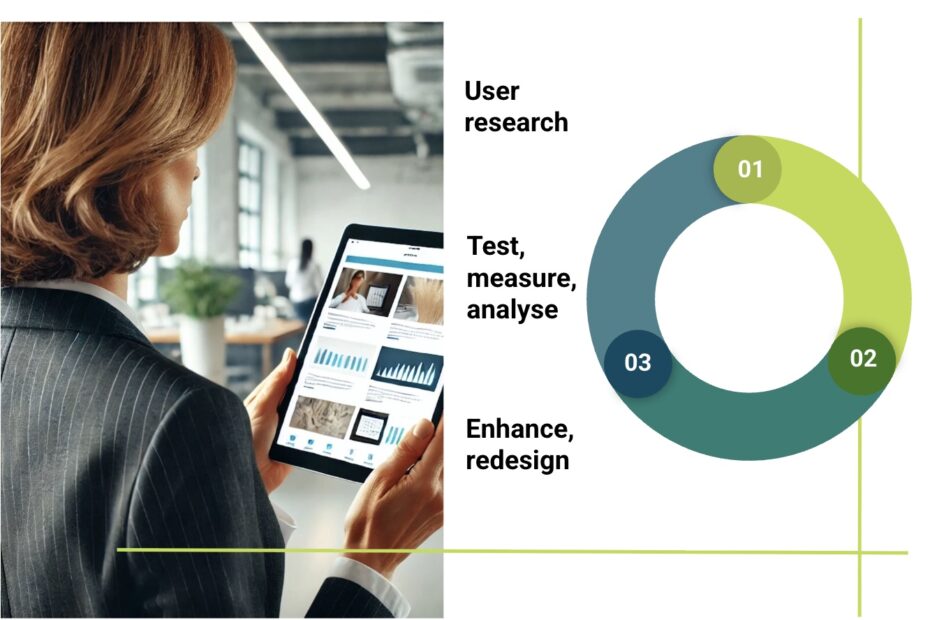
At Digital360Hub, we’ve explored numerous facets of UX optimization and conversion rate optimization. Today, we want to spotlight the three foundational principles that separate exceptional digital experiences from mediocre ones: deep focus on users and their behavior, rigorous testing and measurement, and continuous design iteration.
1. Focus on users and their behavior
At the heart of effective UX design lies a profound understanding of users. The user-centered design principle, coined in the 1970s and later popularized by cognitive scientist Don Norman, emphasizes that everything a designer creates should stem from genuine user needs rather than personal preferences or assumptions.
This principle revolves around empathy and the ability to see your product through your users’ eyes. Here are the essential steps to achieve this:
User research: Conduct comprehensive surveys, interviews, and focus groups to gather deep insights about your audience. Understanding demographics, motivations, pain points, and behavioral patterns helps create experiences tailored to real needs. Research methods can include observational studies, contextual inquiries, and ethnographic research to capture how users interact with products in their natural environment.
Personas: Develop detailed user personas based on your research findings. These research-backed character profiles represent different user segments and guide design decisions to meet specific needs. Effective personas include goals, frustrations, preferred channels, and decision-making patterns that help teams stay aligned on who they’re designing for.
User journey mapping: Chart the complete path users take to accomplish their goals with your product. This visualization helps identify friction points, emotional highs and lows, and opportunities for enhancement. Journey maps should capture all touchpoints across different channels and devices to provide a holistic view of the user experience.
By prioritizing user behavior and preferences throughout the design process, we ensure solutions are genuinely user-centric and intuitive rather than designer-centric.
2. Test, measure, analyze
Testing is an integral component of the UX design process. It validates assumptions, uncovers usability issues, and generates data that informs future iterations. According to Nielsen Norman Group research, iterative design with user testing can improve usability by an average of 165% from first to final iteration. This principle involves a cyclical process of testing, measuring, and analyzing:
Usability testing: Conduct rigorous usability tests with real users to observe how they interact with your product. Testing can take various forms, including moderated sessions, remote unmoderated testing, card sorting, first-click tests, and five-second tests. Each method reveals different aspects of user behavior and comprehension.
Metrics and analytics: Leverage tools like Google Analytics, heatmaps, session recordings, and user flow analysis to track behavior patterns. Key metrics such as bounce rate, conversion rate, task completion rate, time on task, and error rates provide quantitative insights into user experience quality. These measurements help identify which areas need attention and validate whether design changes achieve intended outcomes.
A/B testing: A/B testing tools are indispensable for data-driven UX optimization. These platforms allow you to create and compare different versions of web pages or app features by splitting traffic between variations. By observing which design performs better in terms of conversion rates, click-through rates, and user engagement, you gain invaluable insights into user preferences and behaviors. This evidence-based approach makes the design process more efficient and effective, ensuring iterations are backed by solid data rather than assumptions.
User feedback: Collect qualitative feedback through surveys, feedback forms, user interviews, and review analysis. This qualitative data complements quantitative metrics and offers a holistic perspective on the user experience, capturing the “why” behind the numbers.
Analyzing data collected from these practices helps identify patterns, anomalies, and areas requiring improvement. The goal isn’t just to collect data but to synthesize insights that drive meaningful design refinements.
3. Iterate the design
Iteration is the backbone of successful UX design. User-centered design is inherently iterative, you refine based on real-world feedback and repeat the process to keep improving. Research shows that interfaces should go through at least three iterations, as some usability metrics may temporarily decrease in certain versions if redesign efforts focus on improving other parameters.
This principle emphasizes flexibility, adaptability, and the recognition that perfection rarely comes on the first attempt:
Prototyping: Create prototypes to visualize design changes and experiment with new ideas before committing resources to full development. Prototypes range from low-fidelity paper sketches and wireframes to high-fidelity interactive models. The spiral model of iterative design suggests starting with low-fidelity, low-cost prototypes early when risk and uncertainty are highest, then progressively increasing fidelity as you validate assumptions.
Feedback loops: Establish structured feedback mechanisms with users and stakeholders to gather input on design iterations. This ensures changes align with both user needs and business objectives. Regular feedback sessions, design reviews, and collaborative workshops help maintain alignment throughout the iterative process.
Agile methodology: Adopt an agile approach to UX design, where iterative cycles are short and focused. This enables rapid experimentation and swift adaptation to user feedback. Frameworks like Scrum and Extreme Programming embed iterative design as a core principle, allowing teams to incrementally build, test, and refine products through repeated cycles.
Continuous improvement: Launch isn’t the finish line, it’s a new beginning. Once a product goes live, monitoring user behavior, collecting analytics, and gathering post-launch feedback feeds insights back into the next cycle. This continuous improvement mindset ensures products evolve alongside user needs and technological advancements.
By embracing iterative design, you create products that adapt and improve over time. Each cycle brings you closer to a more polished, user-friendly experience that resonates with your audience.
Why these principles matter
Effective UX design transcends aesthetics. It ensures every interaction users have with your product is intuitive, efficient, and enjoyable. Studies indicate that AI-driven design tools can reduce design time by up to 30%, and that companies investing in comprehensive UX processes see significant improvements in customer satisfaction and business outcomes.
However, it’s important to acknowledge current challenges in the UX field. Recent industry analyses suggest that the pursuit of growth metrics sometimes overshadows the pursuit of meaningful user experiences. As designers, we must remain vigilant about balancing business objectives with genuine user needs, ensuring we’re creating valuable experiences rather than engagement traps.
Note: While the three principles outlined in this article are widely recognized in the UX design community and supported by extensive research, specific implementation approaches may vary based on project context, resources, and organizational constraints. Always adapt these principles to your specific situation and user base.
The three main principles of UX design, focusing on users and their behavior, rigorous testing and measurement, and continuous iteration, form the foundation for creating exceptional digital experiences. By anchoring your design process in these principles, you’ll build websites and products that not only meet user expectations but exceed them, fostering loyalty and driving long-term success.
By prioritizing users, validating assumptions through testing, and continuously refining the design, we develop products that not only meet but exceed user expectations. Embrace these principles and make them the cornerstone of your design process. To find out how to effectively optimize your website and landing pages, read this guide on how to increase conversions next.
About Digital360Hub: We specialize in UX optimization and conversion rate optimization, helping businesses create digital experiences that resonate with users and drive measurable results. Our approach combines user research, data-driven testing, and iterative design to deliver solutions that balance user satisfaction with business goals.