A/B testing is often portrayed as the holy grail of conversion optimization. And yes—when you have enough traffic, A/B tests are an incredibly powerful way to uncover what truly influences user behavior. Major brands use them to validate design decisions, boost conversions, and scale revenue with scientific precision.
But here’s the truth most marketers don’t talk about:
A/B testing is only effective if your website has enough traffic to produce statistically reliable results.
If your site is small, early-stage, niche, B2B, or simply has low daily traffic, you might spend months running a test only to discover the data is inconclusive. Or worse, you might make decisions based on false positives that hurt your conversions instead of improving them.
At Digital360Hub, we work with many businesses who fall into this “low-traffic but high-growth” stage. The good news? You have plenty of options to optimize your website without relying on traditional A/B testing. In fact, low-traffic websites often see bigger and faster wins using smarter, more strategic experimentation methods.
In this guide, you’ll learn:
- Why classic A/B testing often fails on low-traffic sites
- When A/B testing can still work
- Proven alternatives that deliver faster insights
- How to optimize effectively even with limited traffic
By the end, you’ll know exactly how to approach your experimentation strategy so you can continue improving conversions without waiting months for statistically significant results.
Why traditional A/B Testing fails on low-traffic websites
Classic A/B tests rely on reaching statistical significance, which requires a minimum number of visitors and conversions. When traffic is low, you run into two major issues:
1. You can’t reach statistical significance
A test that normally takes two weeks can stretch into months, or even years, if your sample size is too small. This destroys testing velocity and delays learnings.
2. High risk of false positives
Low traffic creates noisy data. Instead of learning what actually works, you risk making decisions based on randomness and misleading results. In other words, If your traffic is low, traditional 50/50 A/B testing is inefficient at best and damaging at worst.
When A/B Testing is still possible (even with low traffic)
You can run experiments on low-traffic sites, but only under specific conditions:
Expecting a big impact
Tests with small expected lifts (5-10%) require huge sample sizes. But if you’re testing something likely to produce a large improvement (30–80%), you may hit significance faster.
High baseline conversion rates
If many people convert already (e.g., lead-gen, B2B demos), even lower traffic can produce usable data.
Testing bold changes, not micro-optimizations
Forget button colors. Think bigger:
- New hero section
- New layout
- Rewritten value proposition
- Simplified funnel
Drastic changes = bigger lifts = statistically detectable patterns.
Smarter alternatives to A/B Testing for low-traffic sites
You don’t need massive traffic to optimize your website. In fact, the world’s best CROs rely on a mix of qualitative and statistical methods when traffic is limited.
Here are the most effective options:
1. Use Bayesian or Sequential Testing (better for low traffic)
Modern experimentation platforms use smarter statistics that:
- Require fewer visitors
- Allow early stopping
- Produce credible results faster
Examples include:
- Optimizely Stats Engine
- VWO SmartStats
- Convert.com Bayesian testing
This is the closest you can get to A/B testing without the volume.
2. Run time-based (before/after) experiments
Also known as A/B/n over time, this method is simple:
- Launch your new variant
- Collect data for 2–4 weeks
- Compare it to the previous 2–4 weeks
- Adjust for seasonality and traffic quality
Not as pure as an A/B test, but highly effective for low-traffic sites when executed correctly.
3. Lean heavily on Qualitative research
When quantity is limited, the quality of insights becomes your greatest asset.
High-impact qualitative tools:
- Heatmaps (Hotjar, Mouseflow)
- Session recordings
- On-site surveys
- User interviews
- Usability tests
- Heuristic evaluations
- Conversion research (your expertise)
These methods often surface issues that A/B tests would take months to uncover.
4. Prioritize radical redesigns over small tweaks
Low traffic requires boldness. Instead of spending weeks testing tiny changes, make transformative improvements and measure the overall impact.
- New UX flow
- Clearer messaging and value proposition
- Removing friction from forms
- Improving offer structure
You get bigger wins faster—no statistical significance required.
How much traffic do you actually need to A/B test?
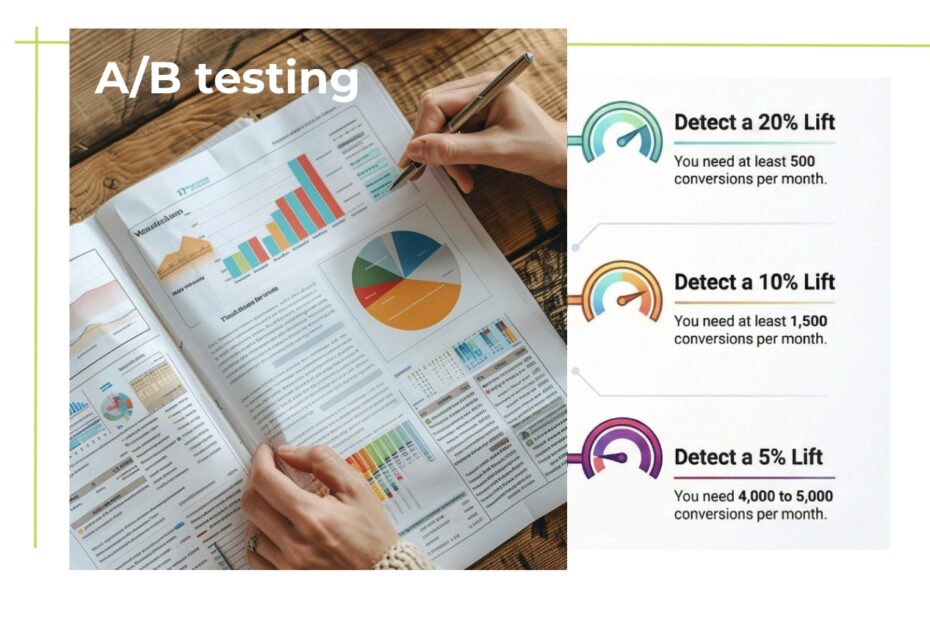
Here’s a quick rule of thumb based on monthly conversions (not visits):
20% expected lift requires at least 500 minimum monthly conversions
10% lift: ≥ 1,500 conversions
5% lift: ≥ 4,000 – 5,000 conversions
If your site generates under 300 conversions per month, classic A/B testing is almost always impractical.
Final verdict: should low-traffic websites A/B test?
If your website doesn’t receive much traffic, traditional A/B testing isn’t your best tool and in many cases, it’s simply not feasible. But that doesn’t mean you need to guess your way through optimization or sacrifice growth. In fact, low-traffic sites have a unique advantage: you can implement bold improvements quickly and measure their impact without relying on slow, complex testing frameworks.
The key is shifting your mindset from “test small changes” to “learn fast, improve big.” Instead of chasing statistical significance, you lean into:
- Deeper customer insights
- High-confidence qualitative research
- Smarter statistical models designed for small samples
- Impactful UX changes that don’t require months of data
When you use the right methods, limited traffic becomes a manageable constraint, not a roadblock. With a strong research-driven process, you can uncover user friction, validate ideas, and improve conversions faster than many high-traffic sites bogged down by corporate testing cycles.
Bottom line:
Low traffic doesn’t limit your ability to grow. It simply requires a different optimization strategy, one that prioritizes learning, bold improvements, and smarter experimentation techniques. If you adopt this approach, you’ll consistently make meaningful progress toward higher conversions, better user experience, and a stronger bottom line.